Conductors vs Insulators — What's the Difference? ⚡
Why does electricity flow through copper but not through plastic? Join Nitvi as she explores conductors, insulators, and the valence electron secret behind it all!
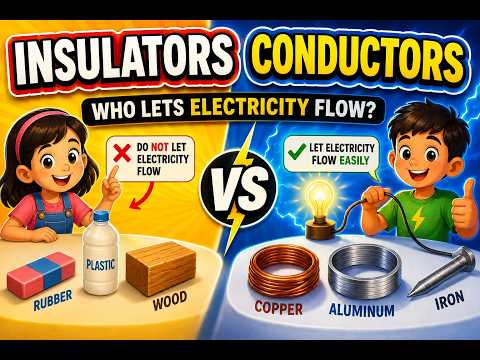
Hi everyone! 👋 Nitvi here!
Last time we learned about valence electrons — the electrons on the outermost shell of an atom that can actually move. But I had a new question:
🤔 If everything is made of atoms, and atoms all have electrons… why does electricity zoom through a copper wire but NOT through plastic or rubber?
The answer is one of the coolest ideas in electronics — and it’s all about valence electrons! ⭐
What Is a Conductor? 🔌
A conductor is a material that lets electricity flow through it easily.
Think of it like a wide open pipe 🏭 — water flows through without any trouble. In a conductor, valence electrons can jump from atom to atom freely. When a battery pushes them, they move — and that’s electricity!
Examples of conductors:
- Copper 🥉 — the most common! That’s why wires are made of copper
- Aluminum — used in power lines
- Gold ✨ — used in tiny electronics chips (it never rusts!)
- Silver — the best conductor of all, but too expensive for wires
What Is an Insulator? 🛡️
An insulator is a material that blocks electricity. Electrons can’t move through it.
Think of it like a blocked pipe 🚫 — no water gets through. The valence electrons in an insulator are stuck. They can’t jump to neighbouring atoms because their outer shell is full.
Examples of insulators:
- Plastic ♻️ — that’s why wires are wrapped in plastic!
- Rubber 🛞 — used in gloves for electricians
- Glass 🔍 — used in high-voltage power line supports
- Air 🌬️ — yes, air is an insulator! (most of the time)
- Wood 🪵 — that’s why you can hold a wooden stick safely
The Valence Electron Secret 🤫
Here’s the big secret — the difference between a conductor and an insulator is ALL about valence electrons:
| Material | Valence Electrons | What Happens |
|---|---|---|
| Copper (conductor) | 1 valence electron | It’s loosely held — jumps easily between atoms! Electricity flows! ✅ |
| Plastic (insulator) | 8 valence electrons (full shell) | They’re snug and happy — no reason to move! No electricity! ❌ |
The Magic Number: 8 🎯
Atoms are happiest when their outermost shell is full. For most atoms, that means 8 valence electrons (this is called the “octet rule”).
- 8 valence electrons = full shell = stable = no movement = insulator
- 1–3 valence electrons = not full = unstable = electrons want to move = conductor!
Copper has just 1 valence electron. It’s like having one kid sitting alone on the outer edge of a camp fire — super easy for that kid to get up and move! That single electron is what makes copper such an amazing conductor. 🥉
Plastic has a full outer shell of 8 electrons. Those electrons are snug and cozy — they have no reason to go anywhere. No movement = no electricity!
Why Wires Are Made of Copper Wrapped in Plastic 🤔
Now it makes sense! A wire is:
- Inside: Copper (conductor) → lets electricity flow ✅
- Outside: Plastic (insulator) → stops electricity from escaping ❌
If the wire was just bare copper with no plastic coating, the electricity could escape into anything it touches — your hand, a metal table, another wire. That’s dangerous! ⚡
The plastic coating keeps the electricity inside the wire and safe. It’s like a water pipe — the copper is the hollow inside where water flows, and the plastic is the pipe wall that keeps it contained. 💧
What About Semiconductors? 🧪
There’s a third type of material that’s really interesting — semiconductors! These are materials that are in between conductors and insulators. They can act like a conductor OR an insulator depending on conditions.
Silicon is the most famous semiconductor — it’s what computer chips and Arduino boards are made of! 🖥️
We’ll learn more about semiconductors later, but for now just remember: conductors let electricity flow, insulators block it, and semiconductors can do both! 🎭
See It in Action! 🔬
Check out this simulation that shows how electricity flows like water. The same idea applies — the “water” (electrons) can only flow if the material lets its valence electrons go!
Press Play to see the story, or tap Copper or Plastic to explore each material. Watch how the valence electrons behave differently — that’s the whole secret! 🔬
Quick Recap! 📝
| Question | Answer |
|---|---|
| What is a conductor? | A material that lets electricity flow (like copper) |
| What is an insulator? | A material that blocks electricity (like plastic) |
| Why is copper a conductor? | It has 1 valence electron — easy to move! |
| Why is plastic an insulator? | Full outer shell (8) — electrons don’t move |
| Why are wires copper inside, plastic outside? | Copper carries electricity, plastic keeps it safe! |
| What’s a semiconductor? | A material that can do both (like silicon) |
What’s Next? 🚀
Now we know about conductors and insulators. But how do we actually control the flow of electricity? What if we want to turn it ON and OFF?
That’s where switches come in — they open and close circuits!
Next time, I’ll learn about open and closed circuits — the switch mystery! 🔌💡
Check out my valence electrons video to learn more about the outer shell superstars, and my first LED project where I learned about circuits the hands-on way! 😅
Join me on Nitvi Talks — 👍 Like, 💬 Comment, 🔔 Subscribe!
See you next time! ⚡🔌