Valence Electrons — The Outer Shell Superstars! ⚡
Why do some materials conduct electricity and others don't? It's all about the electrons on the outside — the valence electrons! Join Nitvi as she explores the outer shell.
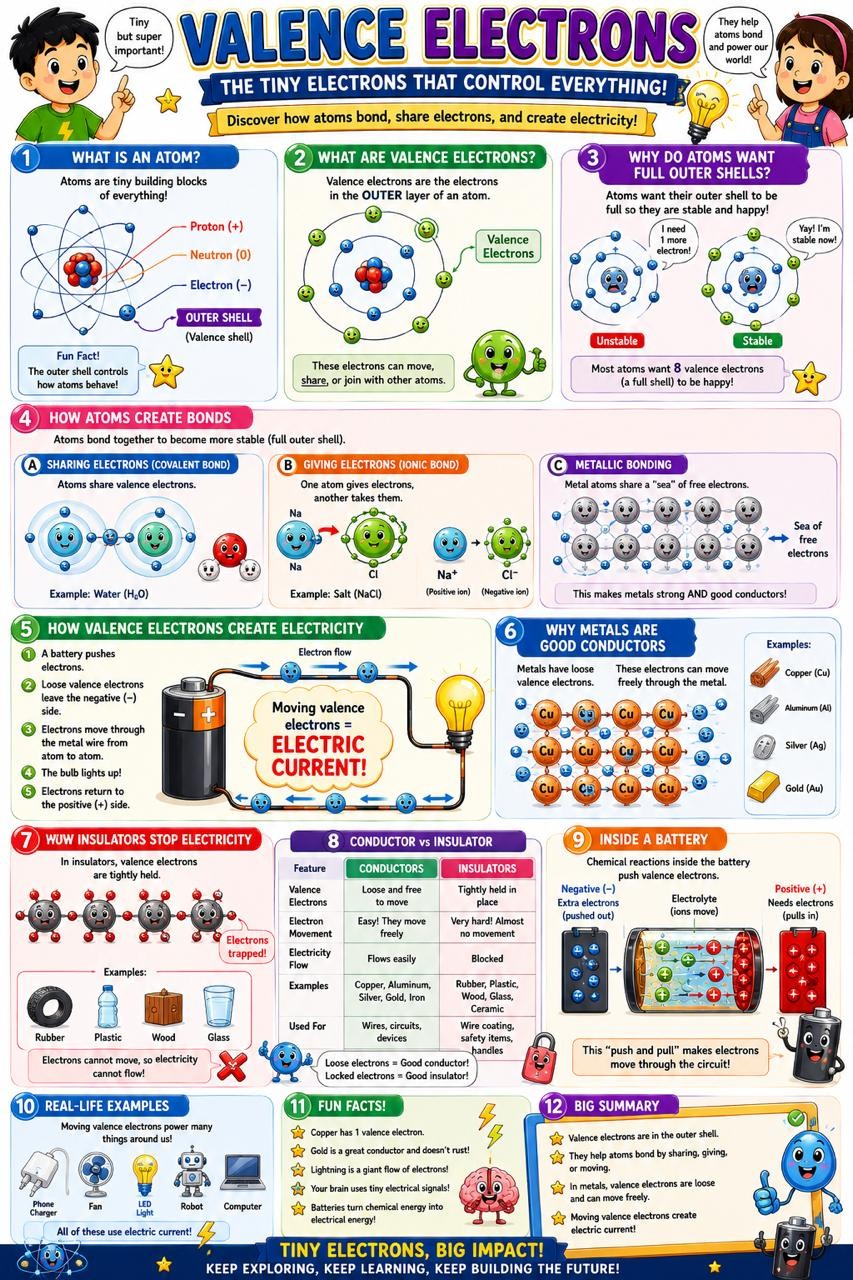
Hi everyone! 👋 Nitvi here!
Last time we learned that electricity is electrons flowing through a wire. But I had a big question:
🤔 If everything is made of atoms, and atoms all have electrons… why don’t ALL materials conduct electricity?
Why does electricity zoom through a copper wire but NOT through plastic or rubber? The answer is one of the coolest ideas in all of electronics:
Valence electrons! ⭐
Atoms Have Layers (Like Onions!) 🧅
Picture an atom like a tiny solar system. The nucleus is the sun in the center, and the electrons zoom around it in layers called shells.
But here’s the thing — electrons don’t all crowd into one big circle. They live in different layers, one inside the other:
- Inner shell — close to the nucleus, very tightly held
- Middle shells — a bit further out
- Outermost shell — the farthest from the nucleus
Think of it like the seats around a camp fire 🔥:
- The kids sitting right next to the fire (inner shell) — they’re warm, cozy, and NOT moving. Nobody can pull them away!
- The kids sitting far away on the outer edge (outermost shell) — they can get up, move around, and even jump to another camp fire!
Those electrons on the outermost shell are called valence electrons. They’re the free spirits! 🏃♀️
Why Valence Electrons Matter ⚡
Valence electrons are the most important electrons in all of electronics. Here’s why:
They’re the farthest from the nucleus, so they’re held loosely. That means they can:
- Jump to neighbouring atoms
- Move freely through a material
- Carry electric current when pushed by a battery
The inner electrons? They’re stuck tight. They never go anywhere. Only valence electrons can move — and moving electrons = electricity!
Conductors vs Insulators — It’s All About the Outer Shell! 🔌
Here’s where it gets really cool. The difference between a conductor (like copper) and an insulator (like plastic) is ALL about valence electrons:
- Few valence electrons (1–3) → they’re loose → electricity flows → conductor! ✅
- Full outer shell (8) → electrons are snug → no movement → insulator! ❌
Copper has just 1 valence electron — that’s why it’s such an amazing conductor! 🥉
I wrote a whole separate post about this — check out Conductors vs Insulators to learn why copper wires are wrapped in plastic, what semiconductors are, and more! 🔌
The Big Idea 💡
Everything in electronics comes down to this:
✨ Valence electrons = the electrons that can move. Moving electrons = electricity.
- The inner electrons don’t matter — they’re stuck. Only valence electrons get to be the heroes! 🦸
- How many valence electrons an atom has determines whether it’s a conductor or an insulator
Quick Recap! 📝
| Question | Answer |
|---|---|
| What are valence electrons? | Electrons on the outermost shell of an atom |
| Why are they special? | They’re held loosely — they can move! |
| Why do they matter for electricity? | Moving valence electrons = electric current |
What’s Next? 🚀
Now we know that valence electrons are the key to electricity. But how do we actually push them so they start moving? That’s where voltage comes in — the push that gets valence electrons flowing!
Next time, I’ll explore what voltage really is and how batteries create that push. 🔋
If you’re learning electronics with me, 👍 like, 💬 comment, 🔔 subscribe on Nitvi Talks!
See you next time! ⚡