Basic Electronics Components Every STEM Explorer Should Know
14 essential components — from LEDs to Arduino — with real photos, analogies, and a learning path to get you building circuits fast!
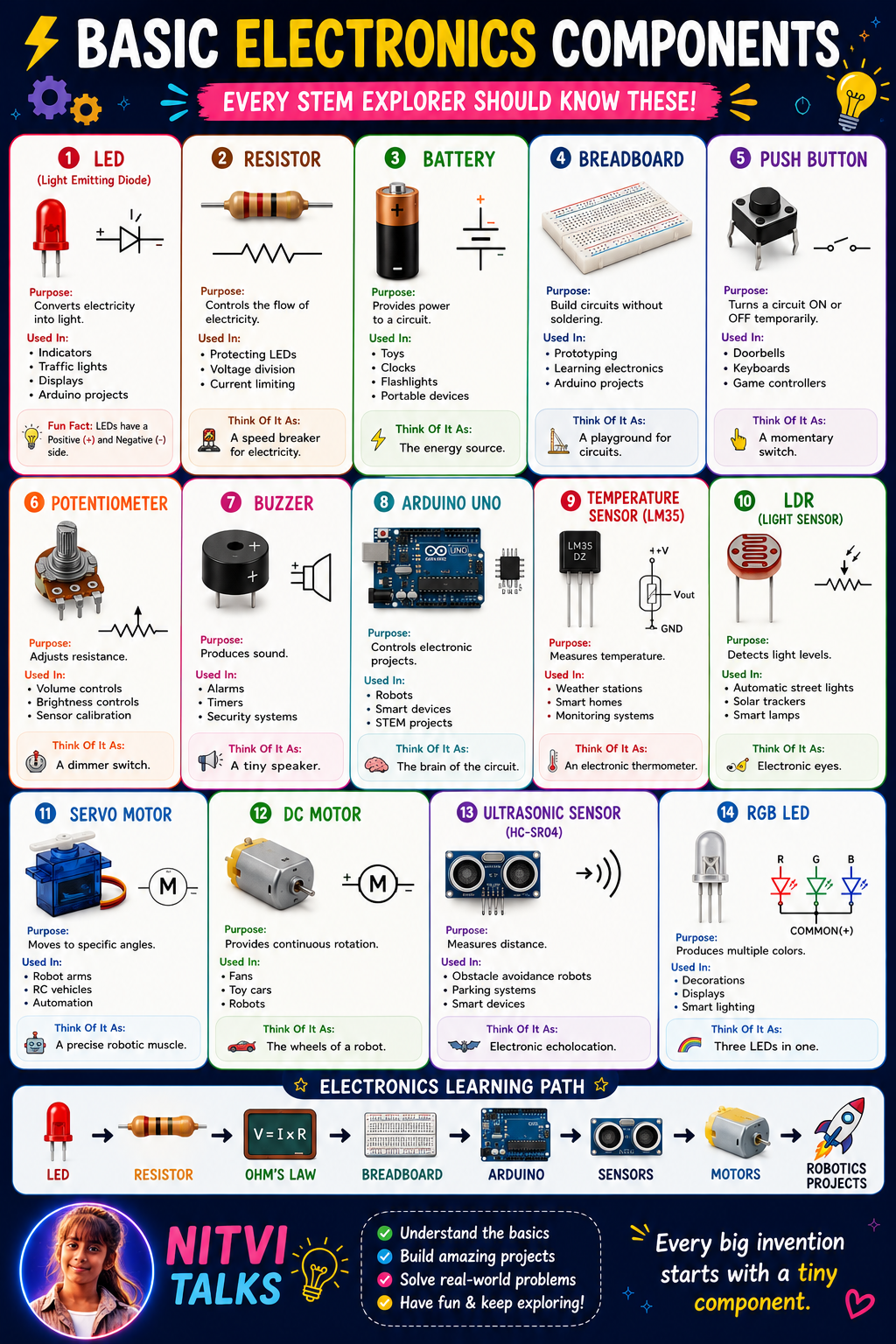
When I started learning electronics, I was amazed by how many little components there are. But once you know the basic ones, you can build almost anything!
I created this infographic to show you all 14 components I think every STEM explorer should know. Let’s go through them one by one.
The 14 Components
1. LED (Light Emitting Diode) 💡
LEDs are tiny lights that run on electricity. They’re in everything — your TV standby light, traffic lights, and Arduino projects.
Fun fact: LEDs have a positive (+) and negative (−) side. If you connect them backwards, they won’t light up!
2. Resistor 🟫
A resistor controls the flow of electricity. Think of it as a speed breaker for electricity — it slows down the current so your LED doesn’t burn out.
I learned this the hard way in my first LED project!
3. Battery 🔋
Batteries provide the power. Without a battery, nothing happens. It’s the energy source for your whole circuit.
4. Breadboard 🔌
A breadboard lets you build circuits without soldering. You just push components into the holes and they connect. It’s like a playground for circuits!
5. Push Button 🔘
A push button turns a circuit ON or OFF temporarily. When you press it, the circuit closes. When you let go, it opens. Think of it like a doorbell — it only works while you’re pressing it.
6. Potentiometer 🎚️
A potentiometer is like a dimmer switch. You turn the knob to adjust the resistance. They’re used in volume controls and brightness controls.
7. Buzzer 🔊
A buzzer produces sound. It’s like a tiny speaker. You’ll find buzzers in alarms, timers, and security systems.
8. Arduino Uno 🤖
The Arduino Uno is the brain of the circuit. It’s a small computer that you can program to control motors, sensors, LEDs, and more. This is what makes everything come alive!
9. Temperature Sensor 🌡️
A temperature sensor measures how hot or cold something is. Think of it as an electronic thermometer. Smart homes use these to control heating and cooling.
10. LDR (Light Sensor) 👁️
An LDR (Light Dependent Resistor) detects light levels. It’s like electronic eyes! Automatic street lights use LDRs to turn on when it gets dark.
11. Servo Motor ⚙️
A servo motor moves to a specific angle. It’s like a precise robotic muscle. Robot arms use servo motors to move to exact positions.
12. DC Motor 🔄
A DC motor provides continuous rotation. Think of it as the wheels of a robot. Fans, toy cars, and robots all use DC motors.
13. Ultrasonic Sensor 📡
An ultrasonic sensor measures distance using sound waves — just like a bat! That’s why I call it electronic echolocation. Obstacle avoidance robots use these to detect walls.
14. RGB LED 🔴🟢🔵
An RGB LED is actually three LEDs in one — red, green, and blue! By mixing these colors, you can produce almost any color. Smart lighting and decorations use RGB LEDs.
The Learning Path
The infographic also shows a suggested learning path:
- Start with LEDs — learn to light one up
- Add a resistor — protect your LED
- Learn Ohm’s Law (V = I × R) — calculate the right resistor
- Use a breadboard — build circuits fast
- Get an Arduino — make things smart
- Add sensors — let your project sense the world
- Add motors — make things move
- Build robotics projects! 🚀
Every big invention starts with a tiny component. Once you know these 14, you have the building blocks for almost any electronics project!
Try My Simulations!
I built interactive simulations to help you understand some of these components:
And if you haven’t seen my YouTube videos about LEDs and Ohm’s Law, check them out:
Remember: Learn → Build → Share → Grow! 🚀