Open and Closed Circuits — The Switch Mystery!
Why does a light turn on when you flip a switch? It's all about open and closed circuits! Join Nitvi as she learns the secret behind every switch.
Have you ever wondered what happens when you flip a light switch? 🤔
One second the room is dark. The next second — boom — light everywhere! ✨
But why? What actually changed when you flipped that switch?
The answer is one of the coolest ideas in all of electronics: open and closed circuits. Let me explain! 💡
What Is a Circuit? 🔄
A circuit is just a complete path for electricity to flow through.
Think of it like a race track 🏁:
- The battery is the starting line — it pushes electrons out
- The wires are the track — the electrons race along them
- The LED or motor is the finish line — the electrons do work there
- Then the electrons go back to the battery and start again!
If the track has no gaps, the electrons can keep racing around and around. That’s electricity flowing! ⚡
The Two Types of Circuits
There are two possible states for any circuit: closed or open.
🔒 Closed Circuit — “The Path Is Complete!”
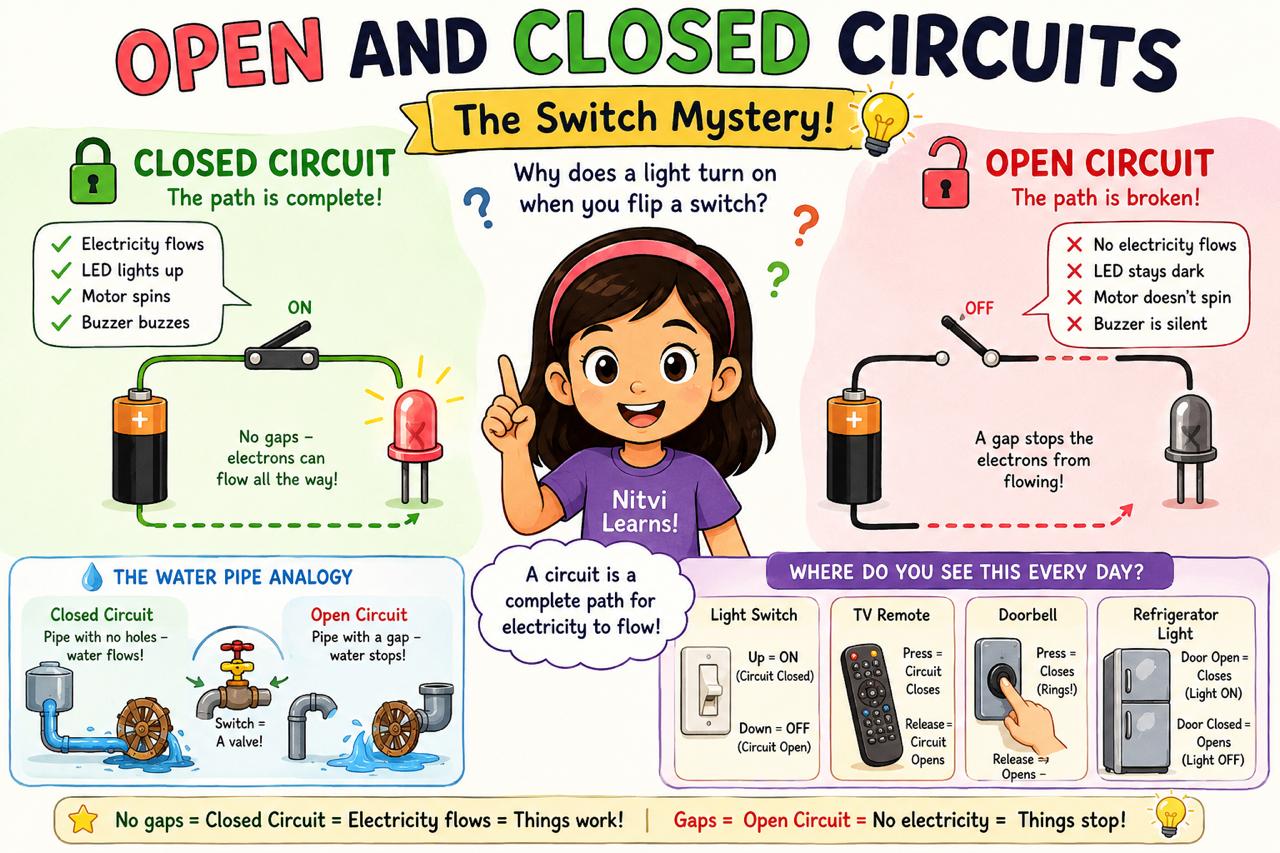
A closed circuit is when the path has no gaps. The electrons can flow all the way around — from the battery, through the wires, through the LED, and back to the battery.
When a circuit is closed:
- ✅ Electricity flows
- ✅ The LED lights up
- ✅ The motor spins
- ✅ The buzzer buzzes
This is what happens when you flip a switch ON. The switch connects the two sides, and the path becomes complete! 🎉
🔓 Open Circuit — “The Path Is Broken!”
An open circuit is when there’s a gap somewhere in the path. The electrons can’t jump across the gap, so they stop flowing.
When a circuit is open:
- ❌ No electricity flows
- ❌ The LED stays dark
- ❌ The motor doesn’t spin
- ❌ The buzzer is silent
This is what happens when you flip a switch OFF. The switch creates a gap, breaking the path! 🔧
The Water Pipe Analogy 💧
Remember how I learned that electricity is like water?
| Circuit Type | Water Analogy |
|---|---|
| Closed circuit | A pipe with no holes — water flows all the way through 🚰 |
| Open circuit | A pipe with a gap — water spills out and stops flowing 🚫 |
| Switch | A valve — turn it to open or close the pipe! |
Imagine a water pipe going from a tank, through a water wheel, and back to the tank. If the pipe is solid all the way around, the water flows and the wheel spins! That’s a closed circuit.
But if someone cuts the pipe and removes a section? The water just spills out at the gap. The wheel stops. That’s an open circuit! 💦
A switch is like a valve — you can open it (break the flow) or close it (let the water through).
Where Do You See This Every Day? 🏠
Open and closed circuits are everywhere in your home:
Light Switch 💡
When you flip the switch up, it closes the circuit — electricity flows to the bulb and it lights up. When you flip it down, it opens the circuit — the path breaks and the light goes off.
TV Remote 📺
When you press a button on the remote, it closes a circuit inside. A tiny chip sends a signal to your TV. When you let go, a small piece of metal pops back up and opens the circuit — the signal stops!
Doorbell 🔔
A doorbell button is normally an open circuit. When someone presses it, they close the circuit — electricity flows to the bell and it rings! When they let go, it opens again. Ding-dong! 🔔
Refrigerator Light 🧊
Ever notice the fridge light turns off when you close the door? There’s a tiny switch that gets pressed when the door closes — that opens the circuit and the light goes off. Open the door, the switch pops out, the circuit closes, and the light comes back on! ✨
What Causes an Open Circuit? 🤔
An open circuit can happen on purpose (like a switch) or by accident:
- A switch — opens and closes the circuit on purpose ✅
- A broken wire — the path is physically cut ⚠️
- A loose connection — a wire came unplugged 🔧
- A blown fuse — the thin wire inside melted to protect the circuit 🛡️
- A burnt-out bulb — the tiny wire inside the bulb broke 💡
When something stops working in your circuit, the first thing to check is: Is there a gap somewhere? That’s troubleshooting 101! 🔍
Try It Yourself! 🧪
If you have a breadboard, a battery, an LED, and some jumper wires, try this:
- Build a complete circuit — battery → wire → LED → wire → back to battery. The LED should light up! That’s a closed circuit! ✅
- Remove one wire — the LED goes dark. You just created an open circuit! ❌
- Add a push button in place of the wire you removed. Now:
- Press the button → circuit closes → LED lights up! 💡
- Release the button → circuit opens → LED goes dark! 🌑
That’s exactly how a switch works! You’re controlling the path of electricity with your finger! 🖐️⚡
The Big Idea 📝
| Concept | What It Means |
|---|---|
| Circuit | A complete path for electricity to flow |
| Closed circuit | The path has no gaps — electricity flows! ✅ |
| Open circuit | There’s a gap — electricity stops! ❌ |
| Switch | A device that opens or closes a circuit on purpose |
| LED on | The circuit is closed |
| LED off | The circuit is open (or something is broken!) |
Every single electronic device in the world uses this idea. Every light, every phone, every computer — they all work by opening and closing circuits to control where electricity goes! 🌍⚡
What’s Next? 🚀
Now I know that electricity needs a complete path to flow. But what if the path has different parts — like wires, switches, and LEDs all connected in different ways?
🤔 How do we draw these circuits so other people can build them too?
Next time, I’ll learn about circuit symbols — the secret language engineers use to draw circuits! Check out my post on reading basic circuit symbols to see what I learned!
Join me on Nitvi Talks — 👍 Like, 💬 Comment, 🔔 Subscribe!
See you next time! ⚡🔌